
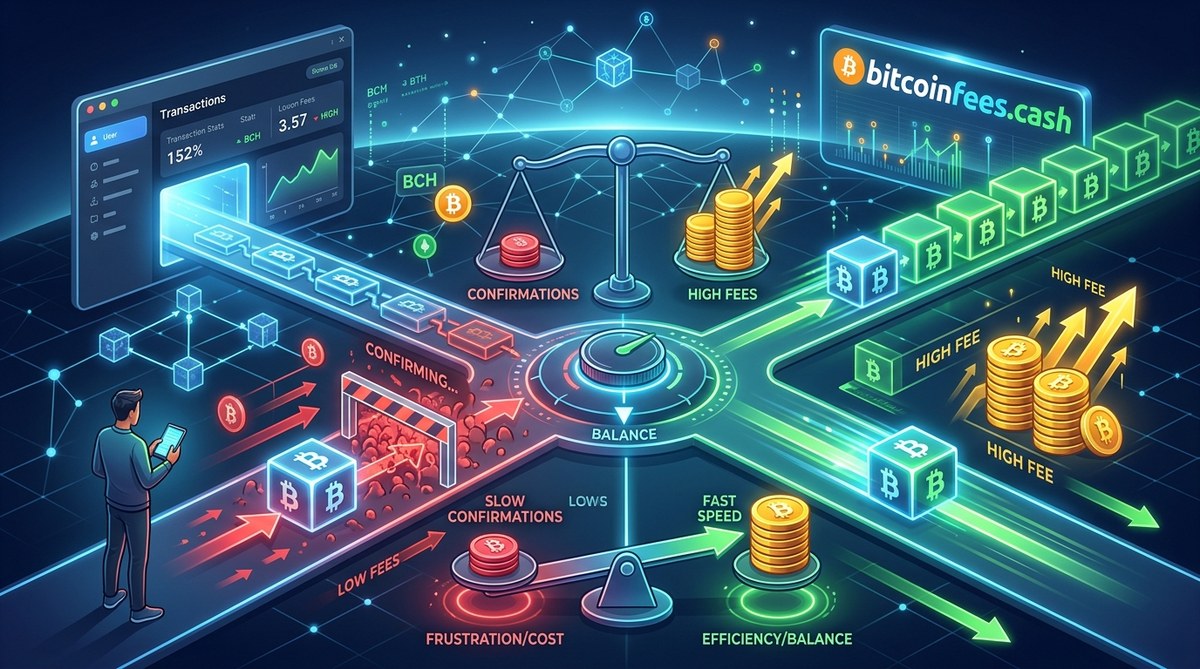
When a Bitcoin transaction sits unconfirmed for hours, the cost is not just the fee you paid. It is the missed payroll run, the delayed inventory shipment, the supplier who will not release goods until they see three confirmations on the blockchain. For finance and logistics professionals, the trade-off between transaction fees and confirmation speed is a daily calculation. Pay too little, and your money gets stuck in the mempool. Pay too much, and you are leaving profit on the table for no reason. The real cost of slow confirmations is not abstract. It is the difference between a smooth supply chain and a cascading delay that costs you customers.
The cost of slow confirmations fees vs speed comes down to timing and network conditions. Paying the highest fee does not guarantee the fastest confirmation, and paying the lowest fee can leave your transaction stranded for hours. The smartest approach is to match your fee to the urgency of the transfer. For time-sensitive freight payments, use fee estimators and consider alternatives like Bitcoin Cash. For routine settlements, batching and off-peak timing save money without risking delays.
Why a Slow Confirmation Costs More Than the Fee
Think about a freight company that needs to pay a trucking partner before a load can cross state lines. The invoice is $15,000. The sender sets a fee of 2 satoshis per byte to save money. The mempool is congested because a popular NFT mint just dropped. That transaction might sit for six hours. Meanwhile, the truck sits at the warehouse. The customer calls. The load misses the delivery window. The penalty for late delivery is $500. The fee savings was $3.
That math does not work.
The hidden costs of slow confirmations include:
- Lost revenue from delayed shipments or service fulfillment
- Overtime labor spent monitoring stuck transactions
- Emergency fees to bump a transaction using Replace-by-Fee (RBF)
- Currency volatility exposure while the transaction is pending
- Damaged vendor relationships when payments do not arrive on time
For logistics professionals, a slow confirmation is not a technical glitch. It is a logistics failure. For finance teams, it is a cash flow disruption that ripples through accounts payable.
The Core Trade-Off: Speed Versus Fee Per Byte
Bitcoin miners prioritize transactions based on fee density, measured in satoshis per virtual byte (sat/vB). The higher your fee rate, the sooner a miner will include your transaction in a block. But the relationship is not linear.
Here is how the trade-off typically looks during normal network conditions:
| Fee Tier (sat/vB) | Typical Confirmation Time | Cost for a 250-byte Transaction | Best Use Case |
|---|---|---|---|
| 1 – 3 | 2 to 6 hours | $0.50 – $1.50 | Non-urgent internal transfers, batching |
| 5 – 10 | 30 to 90 minutes | $2.50 – $5.00 | Standard vendor payments, payroll |
| 15 – 30 | 10 to 30 minutes | $7.50 – $15.00 | Time-sensitive freight payments, supplier releases |
| 50+ | Next block (5-30 min) | $25.00+ | Emergency releases, same-day settlement |
The cost of slow confirmations fees vs speed is most visible in the middle tiers. Paying 5 sat/vB instead of 2 sat/vB might cost you an extra $2.00, but it reduces your wait time from hours to under an hour. For a $50,000 logistics payment, that $2.00 is insurance against a missed deadline.
When Paying More Does Not Help
Here is the counterintuitive part. During extreme mempool congestion, paying more does not always make you faster.
“In a congested mempool, the difference between a 20 sat/vB fee and a 50 sat/vB fee might be one block. That is 10 minutes. But the difference between 2 sat/vB and 5 sat/vB can be four hours. The curve is steep at the low end and flat at the high end.” — Blockchain network analyst, 2026
The mistake many finance teams make is assuming that doubling the fee halves the wait time. It does not. The real leverage is in moving from the “stuck zone” (1-3 sat/vB) into the “flow zone” (5-10 sat/vB). Once you are in the flow zone, paying more gives you diminishing returns.
The 3-Step Process for Balancing Fees and Speed
To manage the cost of slow confirmations fees vs speed effectively, follow this process before every batch of transactions.
-
Check the mempool congestion level. Use a tool like a mempool visualizer to see how many unconfirmed transactions are waiting. If the mempool is over 50 MB, expect higher fees for any speed. If it is under 10 MB, you can use lower fees safely. Learn more about how mempool congestion affects your transaction costs.
-
Classify each transaction by urgency. Split your payments into three buckets: critical (must confirm within 30 minutes), standard (can wait up to 2 hours), and flexible (can wait up to 6 hours). Assign a fee tier to each bucket based on current network conditions. For critical payments during congestion, consider using Replace-by-Fee (RBF) to lower your costs if you initially set the fee too low.
-
Batch non-urgent payments into a single transaction. Instead of sending 10 separate payments, combine them into one transaction with multiple outputs. This reduces the total fee because you pay the base cost once. Learn more about saving on fees by batching transactions.
Alternatives to the Bitcoin Main Chain for Faster Settlement
If your business regularly sends payments that need fast settlement, the main Bitcoin chain might not be the right tool for every job. Here are three alternatives that change the cost of slow confirmations fees vs speed calculation.
-
Bitcoin Cash (BCH): This network offers much lower fees, often fractions of a cent per transaction. Confirmations are faster because blocks are larger and the mempool rarely backs up. For routine vendor payments under $10,000, BCH can settle in minutes for near-zero cost. See why Bitcoin Cash offers lower fees for everyday transactions.
-
Lightning Network: A layer-2 solution that settles payments instantly with minimal fees. It is ideal for high-frequency, low-value transactions like payroll for gig workers or micro-payments in logistics. The trade-off is that you need to open a Lightning channel, which requires an on-chain transaction. Read about using the Lightning Network to cut fees.
-
Timing your transactions during low-traffic periods: Bitcoin network congestion follows patterns. Weekends and late-night hours (UTC) often have lower mempool sizes. If you can schedule payments for Sunday morning, you can use lower fees and still get fast confirmations. Check when Bitcoin fees are lowest for timing your transactions.
Common Mistakes That Inflate the Cost of Slow Confirmations
Finance and logistics professionals often fall into the same traps when managing transaction fees. Here are the most common ones and how to avoid them.
-
Using the wallet’s default fee every time. Most wallets set a default fee that is either too high (to avoid support tickets) or too low (to save money). Neither is optimal. Always check the current mempool and adjust manually. Use fee estimators to pay less without losing speed.
-
Ignoring the “stuck transaction” problem. If you set a low fee and the transaction does not confirm for hours, you may panic and double-spend. That wastes time and money. Instead, use RBF from the start if your wallet supports it. That way, you can increase the fee later without starting over.
-
Treating all payments the same. A $100,000 supplier payment and a $500 office supply payment should not use the same fee strategy. The cost of delay scales with the value of the transaction. For high-value payments, the fee is negligible compared to the risk of delay.
-
Forgetting about time zones. If your vendor is in a different time zone, a 3-hour delay might mean they miss their cut-off for same-day processing. That turns a 3-hour blockchain delay into a 24-hour business delay.
How to Build a Fee Strategy for Your Business in 2026
The most effective approach to managing the cost of slow confirmations fees vs speed is to systematize it. Create a simple fee policy document that your finance team follows for every crypto payment.
Here is a sample policy framework:
-
Tier 1: Emergency (under $50,000, must confirm within 30 minutes)
Use 20-30 sat/vB on BTC, or switch to Lightning for instant settlement. -
Tier 2: Standard (under $10,000, can wait up to 2 hours)
Use 5-10 sat/vB on BTC, or use BCH for near-zero fees. -
Tier 3: Flexible (internal transfers, batching, non-urgent)
Use 1-3 sat/vB on BTC, or batch into one transaction during off-peak hours.
Review your policy monthly based on network trends. In 2026, the fee market is more predictable than it was in 2023, but spikes still happen during major events. Stay informed by understanding Bitcoin network congestion and how to avoid high fees.
The Hidden Cost of Speed: When Paying More Backfires
There is a scenario where paying a high fee actually hurts you. It is rare, but it happens during mempool congestion when many users all pay high fees at once. Miners fill blocks with the highest-paying transactions. But if everyone is paying 50 sat/vB, your 50 sat/vB transaction is no longer special. You just paid a premium for the same confirmation time as someone who paid 30 sat/vB.
This is called “fee auction fatigue.” The solution is to avoid the herd. If you see a mempool spike, wait 30 minutes and check again. Often, the spike resolves within an hour, and fees drop back to normal levels. If you must send during a spike, use a moderate fee (15-20 sat/vB) and rely on RBF to bump it if needed. Learn more about why paying higher fees is not always the fastest way to confirm.
Putting the Strategy to Work
The cost of slow confirmations fees vs speed is a balancing act that every finance and logistics professional needs to master. Pay too little, and you risk operational delays. Pay too much, and you waste margin.
Start by checking the mempool before every batch of payments. Classify each transaction by urgency. Use the right network for the job: BTC for high-value settlements, BCH for routine payments, Lightning for instant transfers. And always have a backup plan, whether that is RBF or a secondary wallet with a different fee strategy.
Your goal is not to pay the lowest fee possible. Your goal is to pay the right fee for the speed you actually need. That is how you keep your supply chain moving, your vendors happy, and your costs under control.










Leave a Reply