

Building on the Bitcoin Cash blockchain offers a refreshing change for developers tired of unpredictable fee markets. You get reliable, low-cost transactions that make microtransactions and everyday payments practical. But building a truly fee-efficient application takes more than just picking the right chain. You need to understand how data, scripts, and network conditions affect your bottom line.
Building fee-efficient apps on Bitcoin Cash means designing for small transaction sizes, using native features like OP_RETURN for data, and batching outputs when possible. By understanding the network’s predictable fee structure, you can keep costs near zero. This guide walks through practical steps to ensure your application stays lean and affordable.
Why Bitcoin Cash Matters for Your Application
Bitcoin Cash was built to scale. Its larger block size and focus on peer-to-peer transactions mean fees stay low even when the network gets busy. For a developer, this changes the math completely. You can build a payment app that works like cash. No waiting ten minutes. No fees that spike during a holiday shopping season.
The key advantage is predictable cost. When you read about why Bitcoin Cash offers lower fees for everyday transactions, you see that the average transaction cost is often a fraction of a cent. This opens up use cases that are impossible on other chains. Think about buying a coffee, tipping a creator, or paying for a single API call.
Understanding the Fee Structure on Bitcoin Cash
Before you write a single line of code, you need to know how fees work on this network. The fee is based on the size of your transaction in bytes, not the amount being sent. A simple payment from one address to another is very small. A complex smart contract with many inputs and outputs will be larger.
Here is a simple breakdown of the elements that add to your transaction size:
- Inputs: Each previous transaction output you spend adds weight. Using many small UTXOs (unspent transaction outputs) increases your fee.
- Outputs: Each recipient address adds bytes. Sending to one person is cheap. Sending to fifty people costs more.
- Scripts: Complex locking scripts, like those used in advanced smart contracts, take up more space.
- Data: Embedding data directly in the transaction (using OP_RETURN) adds to the byte count.
The good news is that you can control all of these. A well-designed application keeps each of these elements as small as possible.
A Practical Process for Building Fee-Efficient Apps
Let’s walk through the steps you should take when designing your application. This process will help you avoid common pitfalls.
-
Design your data model for minimal on-chain footprint. Store large data off-chain (on IPFS, a database, or a sidechain). Only put the cryptographic proof or hash on the Bitcoin Cash blockchain. This is the single most effective way to keep fees low.
-
Batch your payments. If your app needs to send funds to multiple users, do not send separate transactions. Combine them into one transaction with multiple outputs. This saves a huge amount of bytes because you only pay for the overhead of one transaction. See our guide on how to save on Bitcoin fees by batching transactions in 2026 for a deeper look.
-
Use native signature types. The newest signature schemes on Bitcoin Cash are smaller than the original ones. Using SIGHASH flags correctly can also reduce the data needed to sign a transaction. Always check the latest library documentation for the most compact signing method.
-
Monitor mempool conditions. While BCH fees are low, they are not zero. During periods of high network activity, even a small fee difference can affect confirmation time. Use a fee estimator tool to check the current recommended sat/byte rate. You can learn more about how to use fee estimators to pay less for Bitcoin transactions.
-
Test with real data. Do not assume your transaction will be small. Build a test transaction with the exact data your app will use. Broadcast it on the testnet and check the actual byte size. Adjust your code until the transaction is as lean as possible.
Common Mistakes That Inflate Your Costs
Even experienced developers make errors that increase transaction fees. Here is a table of the most common mistakes and how to fix them.
| Mistake | Why It Costs You | How to Fix It |
|---|---|---|
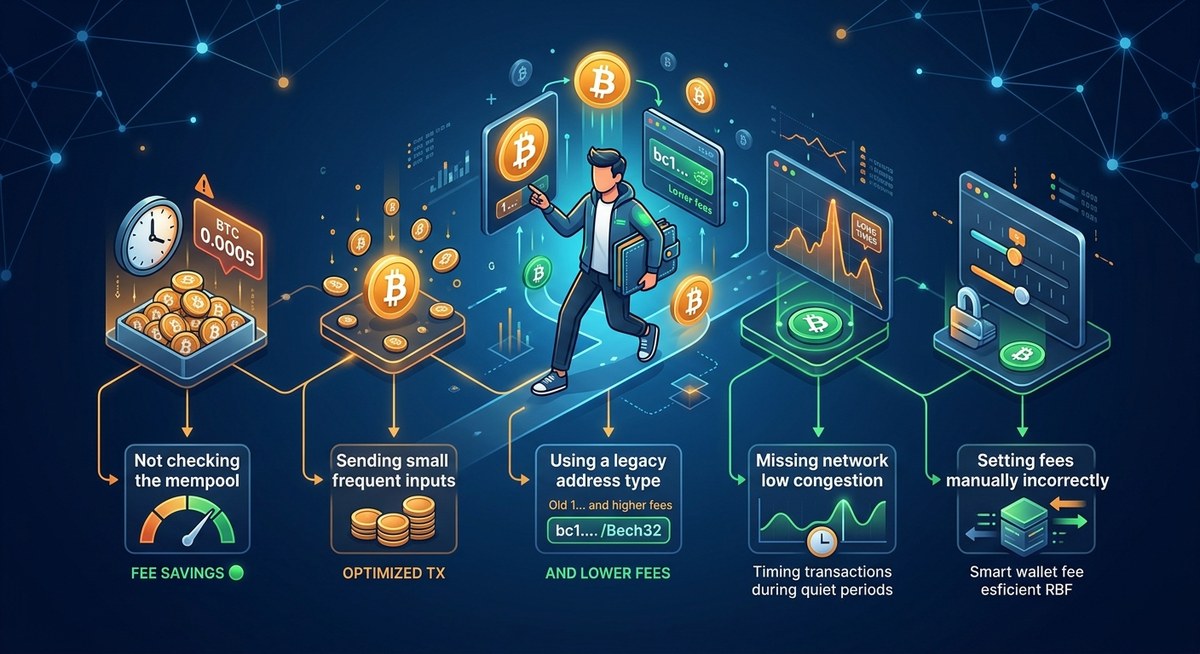
| Using many small UTXOs as inputs | Each input adds ~150 bytes. Ten inputs cost more than one. | Consolidate UTXOs during low-activity periods. Send your funds to a single address when fees are low. |
| Embedding large blobs of data | Data in OP_RETURN or other scripts is expensive per byte. | Use a content hash. Store the full data on a server or a decentralized storage network. |
| Not batching outgoing payments | Each transaction has fixed overhead. Sending 100 payments as 100 transactions is wasteful. | Combine all payments into one transaction with 100 outputs. The overhead is paid only once. |
| Using complex legacy scripts | Older script types are less efficient than modern alternatives. | Migrate to newer, more compact script templates. Check the Bitcoin Cash specification for the latest standards. |
| Ignoring the fee market | Even on BCH, fees can vary slightly. A fixed fee rate might be too high or too low. | Implement a dynamic fee strategy that pulls the current recommended rate from a reliable API. |
Optimizing Data Storage
One of the biggest decisions you will make is how to store data related to your application. Putting everything on the blockchain is tempting because it is immutable, but it is also expensive.
Expert Advice: “Treat the blockchain as a settlement layer, not a database. Store the smallest possible proof on-chain. The actual data belongs in a separate, cheaper system. This keeps your app fast and your fees near zero.” – A lead developer from a major BCH infrastructure project.
For example, if you are building a supply chain tracking app, do not store the entire shipping log on the blockchain. Instead, store a hash of the log. When someone needs to verify a shipment, they can check the hash against the data stored on your server. This approach saves thousands of bytes per transaction.
Tools and Libraries for 2026
The Bitcoin Cash ecosystem has matured. You now have access to robust libraries that handle fee estimation and transaction building for you.
- Cashlib (Python): A clean library for building and signing transactions. It includes fee estimation functions.
- Bitcoin Cash JavaScript Library (BCHJS): Great for web and Node.js applications. It handles UTXO selection and fee calculation.
- Flowee (Rust/C++): For high-performance applications. It gives you fine-grained control over every byte of the transaction.
When you start, use these libraries to build a simple prototype. Check the fee output. Then iterate to make it smaller. You can also use top tools to track network performance and minimize transaction fees to see how your app behaves under different network loads.
Structuring Your Transactions for Scale
If your application will handle thousands of transactions per day, you need a solid strategy. Do not treat each transaction as a one-off event. Build a system.
-
UTXO Management: Keep a wallet service that monitors your UTXO set. When fees are low, run a consolidation transaction to combine many small UTXOs into a few large ones. This prepares your app for high-volume periods.
-
Payment Aggregation: For a marketplace or a content platform, aggregate payments. Instead of paying each creator the moment they earn a dollar, accumulate payments in a ledger. Pay them out once a day or once a week in a single batched transaction. This dramatically reduces your total fee spend.
-
Use the Correct Fee Rate: The default fee rate in many libraries is set for safety. It may be higher than necessary. Test with lower rates. Many BCH transactions confirm with a rate of 1 sat/byte or even less. Read our analysis of what determines your Bitcoin transaction fee in 2026 to understand the variables.
Planning for Network Conditions
The Bitcoin Cash network is not immune to spikes in usage. A popular airdrop or a major event can fill the mempool. While fees will still be low compared to other chains, they can rise from near zero to a few cents.
Build a monitoring layer into your app. If the recommended fee rate rises above your threshold, pause outgoing transactions. Queue them and wait for the mempool to clear. This is a standard pattern in professional crypto applications. You can learn more about how to leverage network conditions in 2026 to minimize Bitcoin transaction fees.
Your Next Steps as a Developer
You now have the knowledge to build a fee-efficient application on Bitcoin Cash. Start by mapping out your data flow. Identify every point where your app touches the blockchain. For each touch point, ask: “Can I make this smaller? Can I batch it? Can I store this data off-chain?”
Build a small test on the testnet. Use the libraries mentioned above. Check the actual fees. You will likely be surprised at how cheap a well-designed transaction can be. Then, scale up. Your users will thank you when they can send a payment for a fraction of a cent.
The combination of predictable low fees and a developer-friendly environment makes Bitcoin Cash a strong choice for 2026. By following the practices in this guide, you can build applications that are not only innovative but also economically viable for real-world use. Go build something that works like cash should.









Leave a Reply